
Quick Answer
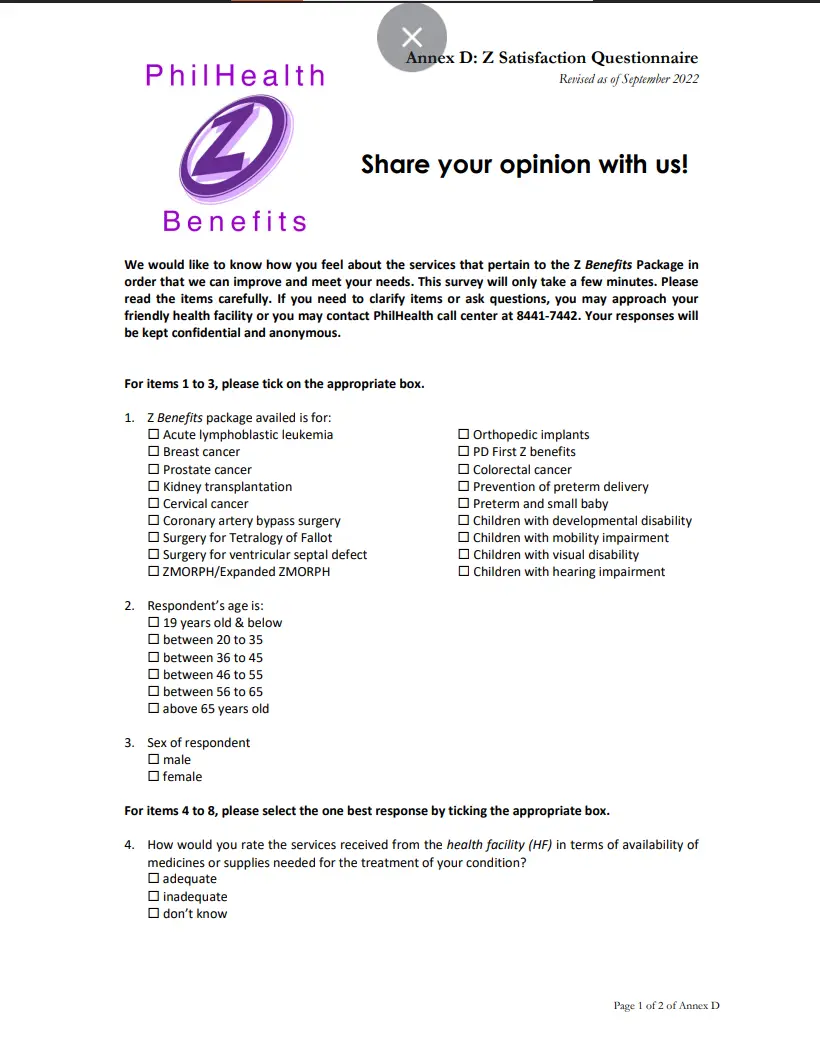
PhilHealth Z Benefits, also called the Z Benefit Package, is a specialized coverage program for catastrophic, high-cost illnesses like certain cancers, kidney transplant, and coronary artery bypass graft surgery, offering coverage that can exceed ₱1 million per case at zero balance billing for basic ward care. Unlike standard hospitalization, Z Benefits require pre-authorization from PhilHealth before treatment begins, processed through your attending physician and a Z Benefit-contracted hospital’s PhilHealth desk.
Every member and their qualified dependents can apply, regardless of employment category, as long as the specific illness is on PhilHealth’s approved list and the hospital is contracted for that condition. The application itself isn’t something you do entirely on your own it’s largely handled by your doctor and the hospital, though understanding the process helps you avoid the delays that come from missing paperwork or choosing a facility that isn’t accredited for your specific diagnosis.
What Is the PhilHealth Z Benefit Package?
The Z Benefit Package is PhilHealth’s coverage program for “catastrophic and life-threatening” illnesses, introduced in 2012 to protect members from the crippling out-of-pocket costs of conditions like cancer and organ transplant. Rather than a fixed case rate deducted at discharge, Z Benefits function as a full-continuum payment covering diagnosis, treatment, and follow-up care within the package’s defined scope, at facilities specifically contracted for that condition.
The “Z” in Z Benefits doesn’t stand for anything literal; it was chosen to represent the far end of the alphabet, symbolizing the most severe tier of illness PhilHealth covers, beyond standard case rates. This is part of why Z Benefits work differently from ordinary hospitalization claims. Where a typical case rate is deducted automatically from your bill at discharge, Z Benefits require approval before treatment starts, since the total cost and duration of care for a catastrophic illness can’t be captured in a single, same-day deduction.
You can check your membership status and contribution history anytime through the PhilHealth Portal before applying for Z Benefits.
The Full List of Z Benefit Covered Illnesses
PhilHealth assigns each Z Benefit condition its own code, and the current list covers nine primary packages.
|
Code |
Condition |
|---|---|
|
Z001 |
Acute lymphocytic/lymphoblastic leukemia, standard risk (children) |
|
Z002 |
Early breast cancer, stage 0 to IIIA |
|
Z003 |
Prostate cancer, low to intermediate risk |
|
Z004 |
Kidney transplantation for end-stage kidney disease, standard risk |
|
Z005 |
Coronary artery bypass graft (CABG) surgery, standard risk |
|
Z006 |
Total correction of Tetralogy of Fallot (children) |
|
Z007 |
Closure of ventricular septal defect (children) |
|
Z008 |
Cervical cancer, stage I to IV |
|
Z009 |
Z-MORPH (Mobility, Orthosis, Rehabilitation and Prosthesis Help) |
PhilHealth has also expanded coverage for colon and rectal cancer and peritoneal dialysis in more recent circulars, and the list can grow further through PhilHealth Board Resolutions as new conditions are added. If you’re researching a specific illness not listed here, checking PhilHealth’s most current circular directly, or asking your hospital’s PhilHealth desk, confirms whether a newer package now applies.

How Much Does Each Z Benefit Cover?
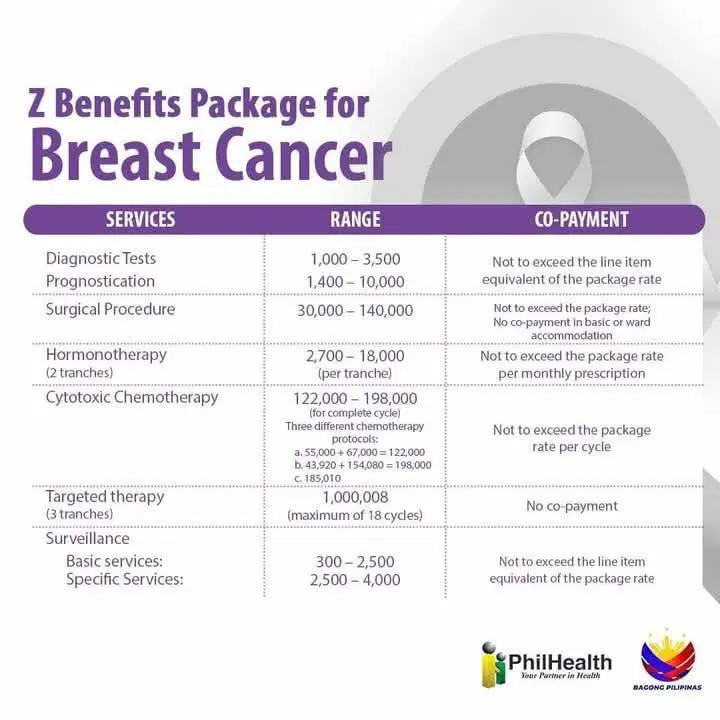
Z Benefit coverage amounts vary significantly by condition, ranging from roughly ₱100,000 for some packages to over ₱2 million for kidney transplant from a deceased donor. Breast cancer coverage alone was raised from ₱100,000 to ₱1.4 million in 2024, and kidney transplant coverage jumped from ₱600,000 to ₱2 million in 2025, reflecting some of the largest benefit increases PhilHealth has made to any package. You can also review the latest PhilHealth Case Rates to understand how much financial assistance is available for different medical conditions.
|
Condition |
Approximate Coverage |
|---|---|
|
Early breast cancer |
Up to ₱1,400,000 |
|
Childhood acute lymphocytic leukemia (standard risk) |
Around ₱500,000 |
|
Kidney transplant (living donor) |
Around ₱600,000–₱1,000,000 |
|
Kidney transplant (deceased donor) |
Up to ₱2,140,000 |
|
Coronary artery bypass graft surgery |
₱550,000–₱600,000 |
|
Cervical cancer |
Varies by stage, several hundred thousand pesos |
|
Z-MORPH prosthetics |
Tens of thousands, varies by device |
These figures are set by PhilHealth circular and get revised periodically, so treating them as a general reference rather than a locked-in number is the safer approach. Confirming the exact current amount for your specific diagnosis with the hospital’s PhilHealth coordinator before treatment avoids planning around an outdated figure. Z Benefits are one of the specialized PhilHealth Benefits designed to cover catastrophic illnesses and high-cost treatments.
Who Can Avail of Z Benefits?
Every PhilHealth member and their qualified dependents can apply for Z Benefits, regardless of whether they’re employed, self-employed, an OFW, a lifetime member, or under the sponsored program, as long as their specific illness matches one of PhilHealth’s covered Z Benefit conditions. Membership category doesn’t create any additional restriction beyond the standard contribution requirement.
To qualify, a member generally needs at least three months of contributions within the six months immediately before availment, similar to the requirement for standard hospitalization benefits. If your contributions have lapsed, settling that first is a necessary step before a Z Benefit application can move forward, since an inactive account will stall the process regardless of how urgent the diagnosis is.
Requirements to Apply for Z Benefits
If your PBEF is marked “Yes,” you generally don’t need to submit your MDR and CF1 separately, since the eligibility form already confirms your active status. This is one detail that trips up applicants who assume every document is always required regardless of what their PBEF shows.
Step-by-Step: How to Avail of Z Benefits
Most of the administrative work in this process sits with your doctor and the hospital’s PhilHealth desk rather than with you directly, though staying in close contact with them throughout speeds things along. Since most Z Benefit packages require hospital confinement, it’s helpful to understand how PhilHealth Hospitalization coverage works.
How to Find a Z Benefit-Contracted Hospital
Not every PhilHealth-accredited hospital is contracted for Z Benefits, and accreditation is condition-specific rather than blanket. A hospital might be contracted for breast cancer treatment but not kidney transplant, since each package requires specialized departments, equipment, and trained specialists specific to that illness.
Major government facilities like the Philippine General Hospital, Philippine Heart Center, Lung Center of the Philippines, National Kidney and Transplant Institute, Philippine Children’s Medical Center, and East Avenue Medical Center are commonly contracted across several Z Benefit categories, alongside a number of private tertiary hospitals.
PhilHealth maintains an official list of Z Benefit-contracted facilities by condition, available through its website or by request at any PhilHealth branch. Confirming a specific hospital’s accreditation for your exact diagnosis before committing to treatment there prevents the frustrating discovery, mid-process, that the facility can’t actually process your particular Z Benefit package.
What’s Included and What’s Not
A Z Benefit package is designed to be comprehensive within its defined scope, covering operating room expenses, drugs and laboratory examinations, hospital room and board, and professional fees for the entire course of treatment tied to that specific condition.
At contracted government hospitals, this often means genuinely zero out-of-pocket cost for basic ward patients who meet clinical eligibility. At contracted private hospitals, the package typically offsets most of the bill, though some excess cost may still fall on the patient depending on the facility’s own pricing.
What isn’t covered includes anything explicitly outside the package’s scope, such as experimental medications not part of the standard protocol, a private or semi-private room upgrade, or additional procedures unrelated to the core Z Benefit treatment plan. Confirming exactly what’s included with the hospital’s PhilHealth coordinator before treatment begins avoids an unexpected bill for something you assumed was bundled into the package.

Timeline: How Long Does Pre-Authorization Take?
Pre-authorization for Z Benefits generally takes up to seven working days once the hospital submits a complete request to the nearest PhilHealth Regional Office. This is notably slower than a standard case rate deduction, which applies instantly at discharge, since Z Benefits require PhilHealth to review and approve the case before treatment even starts.
Because treatment for catastrophic illnesses often can’t wait, hospitals typically begin the pre-authorization process as early as possible once a diagnosis is confirmed, rather than after the first consultation is already scheduled.
If your specific case involves urgent surgery, discussing the pre-authorization timeline directly with your attending physician helps set realistic expectations for when treatment can actually begin.
Z Benefits for Breast Cancer, Kidney Transplant, and Other High-Demand Conditions
Breast cancer remains one of the most frequently claimed Z Benefit packages, and its 2024 increase from ₱100,000 to ₱1.4 million reflects PhilHealth’s recognition that earlier coverage fell far short of actual treatment costs, which can otherwise range from ₱120,000 to well over ₱1 million depending on stage and treatment protocol.
Kidney transplant coverage saw an even larger jump, rising over 230 percent from ₱600,000 to ₱2 million for procedures involving a deceased donor, alongside an expansion of hemodialysis sessions from 90 to 156 per year for members managing chronic kidney disease while awaiting or instead of transplant.
Cervical cancer, prostate cancer, and CABG surgery round out the most commonly claimed packages, each with coverage tied to the stage or risk classification of the specific case. If you’re managing one of these diagnoses, asking your specialist directly whether your case classification, such as early-stage versus advanced, changes which specific package amount applies is worth doing early, since staging can affect both eligibility and coverage level.
What’s Not Yet Covered
Lung cancer is not currently covered under PhilHealth’s Z Benefits list, despite being one of the leading causes of cancer mortality in the Philippines. A nationwide patient petition launched in early 2026 has urged PhilHealth to add lung cancer to the program, though as of this writing it remains outside the approved list.
This gap matters for patients and families researching coverage for a lung cancer diagnosis, since standard case rates rather than the more comprehensive Z Benefit structure would apply instead. Checking PhilHealth’s current circular list before assuming coverage for any less common or newly diagnosed condition avoids planning finances around a benefit that may not yet exist for that specific illness.
Common Mistakes That Delay Z Benefit Approval
Troubleshooting a Denied Z Benefit Application
If a Z Benefit pre-authorization request is denied or returned, start by asking the hospital’s PhilHealth desk for the specific reason, since this is usually tied to either membership status, incomplete clinical documentation, or a diagnosis that doesn’t precisely match the covered condition’s criteria.
If your PBEF came back marked “No,” submitting your MDR and CF1 as proof of active membership is typically the direct fix rather than treating the denial as final. For unresolved cases, PhilHealth’s Corporate Action Center or the nearest Regional Office can review the specific application further, so keeping copies of your clinical summary, PBEF, and any correspondence on hand speeds up that follow-up.
Tips for a Smoother Z Benefit Journey
Confirm your membership contributions are current as soon as a serious diagnosis is suspected, rather than waiting until treatment planning is already underway. Ask your specialist directly which Z Benefit code applies to your specific case, since staging and risk classification affect both eligibility and the exact coverage amount.
Choose a hospital already contracted for your specific condition from the start, rather than discovering partway through that your preferred facility only handles a different Z Benefit package. Keep a dedicated folder of every document related to your application, including your PBEF, clinical summary, and pre-authorization correspondence, since catastrophic illness treatment often spans months and multiple hospital visits.
Frequently Asked Questions

I’m Dayon, and I run PhilHealthPH.com. I got tired of confusing, outdated instructions every time I had to deal with PhilHealth online, so I started writing the guides I wished existed — clear, current, and focused on actually getting the task done. Everything here is checked against PhilHealth’s official site and updated whenever their process changes.