
Quick Answer
To file a PhilHealth claim for reimbursement, gather your Claim Form 1, Claim Form 2 signed by your doctor, original official receipts, an itemized Statement of Account, and proof of active membership, then submit everything to the PhilHealth office nearest you within 60 calendar days of discharge. This route applies mainly when you were treated at a non-accredited facility, paid the full bill out of pocket, or the automatic hospital deduction didn’t go through.
Most PhilHealth members never file a claim personally, since accredited hospitals handle the deduction and paperwork automatically during confinement. Filing becomes your responsibility only when that automatic process breaks down. Knowing what to prepare and how tight the deadline actually is can mean the difference between getting your money back and losing it permanently.
When Do You Actually Need to File a Claim Yourself?
You need to file a claim directly when you were confined at a facility not accredited with PhilHealth, when you paid your entire hospital bill without any PhilHealth deduction applied, or when a documentation error prevented the hospital from processing the claim on your behalf. Confinements abroad also require direct filing, since PhilHealth has no accredited facilities overseas.
If your hospital is accredited and everything went smoothly, the case rate deduction should already appear on your Statement of Account before discharge, meaning you don’t need to do anything further. Direct filing is essentially a backup route for situations where the standard, automatic process wasn’t available or didn’t work as expected. Before filing your claim, make sure your membership information is updated through the PhilHealth Portal.
Requirements for Filing a PhilHealth Reimbursement Claim
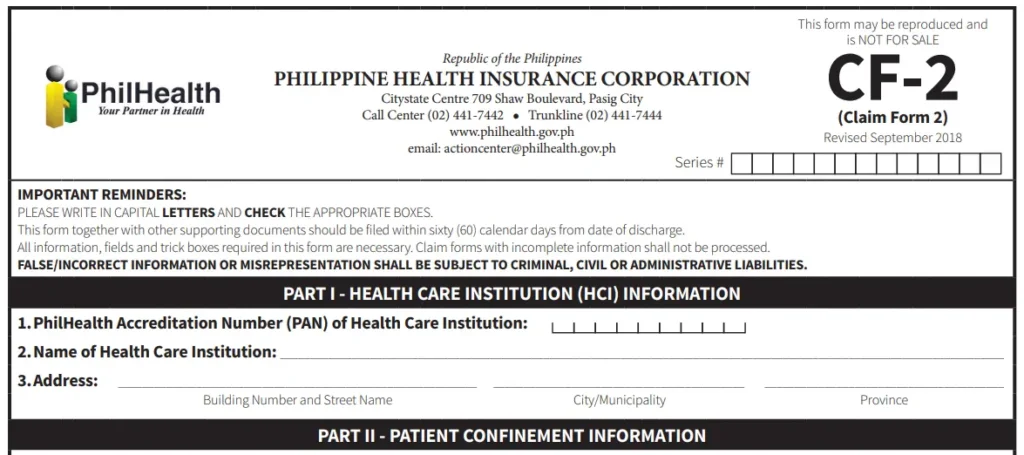
Getting CF2 signed is often the slowest part of this list, since it depends on your doctor’s availability. Ask for it before leaving the hospital, or follow up the same day if your physician has already gone, since every day spent waiting eats into your 60-day filing window.
Step-by-Step: How to File a PhilHealth Claim
Filing through the Member Portal has become the faster option for many members, since it supports document uploads in PDF or JPG format without an in-person branch visit. Understanding your available PhilHealth Benefits will help you determine which medical expenses are covered before filing a claim.
How to File a Maternity Claim Specifically
To file a maternity claim, your membership needs to be active with at least three monthly contributions within the six months before delivery, and your spouse or the child’s father should already be registered as a dependent, if relevant, before the delivery date. The claim follows the same basic document requirements as any other reimbursement, plus records specific to the delivery.
Most maternity claims are processed automatically if you deliver at an accredited hospital or lying-in clinic, with the case rate deducted directly from your bill. If you need to file for reimbursement instead, bring your CF1, CF2 signed by the attending physician or midwife, the newborn’s birth record, and your official receipts.
Confirming your dependents are properly listed before delivery, rather than after, prevents a stalled claim later. Most hospital claims require a properly completed PhilHealth CSF, so be sure to prepare this document before submission.
The 60-Day Deadline (and the 180-Day Rule for OFWs)
Reimbursement claims for confinements within the Philippines must be filed within 60 calendar days from the date of discharge. For benefits availed abroad, members have 180 calendar days from discharge, or from their return to the Philippines, to file.
This deadline is strict, and PhilHealth generally denies late claims without an appeals process, except in documented force majeure situations covered under specific circulars. Since gathering a signed CF2 or waiting on hospital paperwork can eat up weeks without you realizing it, treating day 45 as your personal hard deadline, rather than day 60, gives you a buffer if something unexpected comes up.
Claims for confinements abroad also need supporting documents translated into English if the original records are in another language.
How Much Does PhilHealth Actually Reimburse?
PhilHealth reimburses the case rate amount assigned to your specific diagnosis or procedure, not the full amount you actually paid. If your total hospital bill was higher than the case rate, the difference remains your responsibility, whether through an automatic deduction or a reimbursement claim.
This trips up a lot of first-time filers who assume reimbursement means getting their entire payment back. A patient who paid ₱120,000 out of pocket for a procedure with a ₱31,000 case rate receives ₱31,000 back, not the full amount. Checking the applicable case rate for your diagnosis before filing helps set realistic expectations about how much you’ll actually recover.
How Long Does Processing Take?
Reimbursement claims generally take 30 to 60 working days to process once PhilHealth receives a complete set of requirements, though complex cases or claims with missing documents can take longer.
Claims filed at an accredited hospital and deducted automatically, by contrast, are processed instantly and reflected before you’re even discharged.
If it’s been well beyond 60 working days without any update, following up with your claim reference number, either through the Member Portal or PhilHealth’s hotline, is worth doing. Incomplete documentation is the most common reason a claim stretches past the standard timeframe.
How to File a Claim Adjustment
If PhilHealth returns your claim for correction or you discover an error after submission, such as an incorrect case rate code or missing signature, submit the corrected documents within the timeframe stated in the return notice, generally within 60 days of receiving it.
This is handled as a resubmission rather than a brand-new claim, so keeping your original reference number on hand speeds things up.
Common reasons for a claim adjustment include a diagnosis code that doesn’t match your medical records, a missing employer certification, or a Statement of Account that isn’t itemized clearly enough for PhilHealth to verify.
Contacting the PhilHealth office handling your claim, rather than starting over from scratch, is the more efficient way to resolve this kind of correction.
Common Mistakes That Get Claims Denied
Troubleshooting a Denied or Delayed Claim
If your claim is denied, start by requesting the specific reason from the PhilHealth office handling it, since most denials fall into a handful of categories: missed deadlines, inactive membership, or incomplete documentation.
If the issue is correctable, such as a missing signature or an unclear Statement of Account, ask whether a claim adjustment or resubmission is possible rather than assuming the denial is final. For claims that have simply gone quiet without a decision, calling PhilHealth’s Corporate Action Center with your claim reference number usually gets a status update faster than waiting.
Tips for a Smooth Filing Process
Request your Claim Form 2 before leaving the hospital, since chasing down a doctor’s signature after they’ve moved to other patients is the most common source of delay. Keep photocopies of every document you submit, including receipts and forms, in case anything needs resubmitting later.
Set a personal deadline around day 45 rather than day 60, giving yourself a buffer for unexpected delays like a doctor’s unavailability. Whenever possible, choose an accredited facility for planned procedures, since letting the hospital handle the claim automatically avoids the filing process altogether.
Frequently Asked Questions

I’m Dayon, and I run PhilHealthPH.com. I got tired of confusing, outdated instructions every time I had to deal with PhilHealth online, so I started writing the guides I wished existed — clear, current, and focused on actually getting the task done. Everything here is checked against PhilHealth’s official site and updated whenever their process changes.