Quick Answer
The PhilHealth Newborn Care Package (NCP) covers essential health services given to a baby within the first hours and days of life, including Vitamin K, eye prophylaxis, BCG and Hepatitis B vaccination, newborn screening, and a hearing test. It was enhanced under PhilHealth Circular 2018-0021, raising the package amount from ₱1,750 to ₱2,950 effective January 2019, and the exact figure has been adjusted further in later circulars, so confirming the current rate with your hospital’s PhilHealth desk is worth doing before delivery.
The package is automatically available to every newborn delivered at a PhilHealth-accredited hospital, infirmary, or birthing home, filed as its own separate claim rather than bundled into the mother’s delivery claim. Most parents never need to do anything beyond providing the baby’s birth certificate, since the facility typically processes this benefit as part of standard newborn care.
What Is the PhilHealth Newborn Care Package?
The Newborn Care Package is PhilHealth’s benefit for a baby’s essential care immediately following birth, separate from the Maternity Care Package that covers the mother’s delivery. It exists to make sure every newborn receives a defined set of preventive and screening services regardless of the family’s ability to pay out of pocket.
PhilHealth designed the NCP around reducing infant morbidity and mortality by catching congenital disorders early, before they develop into lifelong conditions far more costly to manage. The package applies at any PhilHealth-accredited facility that performs deliveries and provides newborn care, including hospitals, infirmaries or dispensaries, and birthing homes or lying-in clinics.
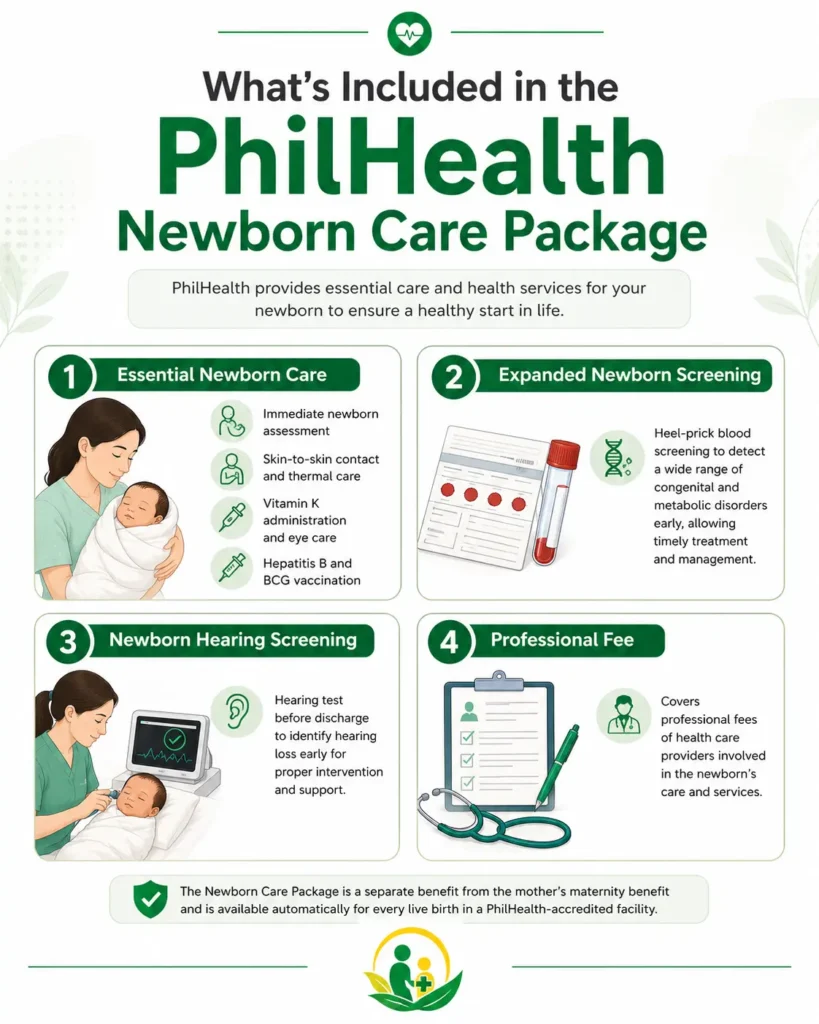
What’s Included in the Package
The Newborn Care Package bundles together the specific interventions a baby needs in the first hours and days after delivery.
Facilities record Hepatitis B and BCG vaccination under drugs and medicines on the claim form, while newborn screening and hearing tests fall under laboratories, supplies, and other services. Parents don’t need to track this coding detail themselves, but it explains why the claim sometimes looks itemized differently than the mother’s.
How Much Does the Newborn Care Package Cover?
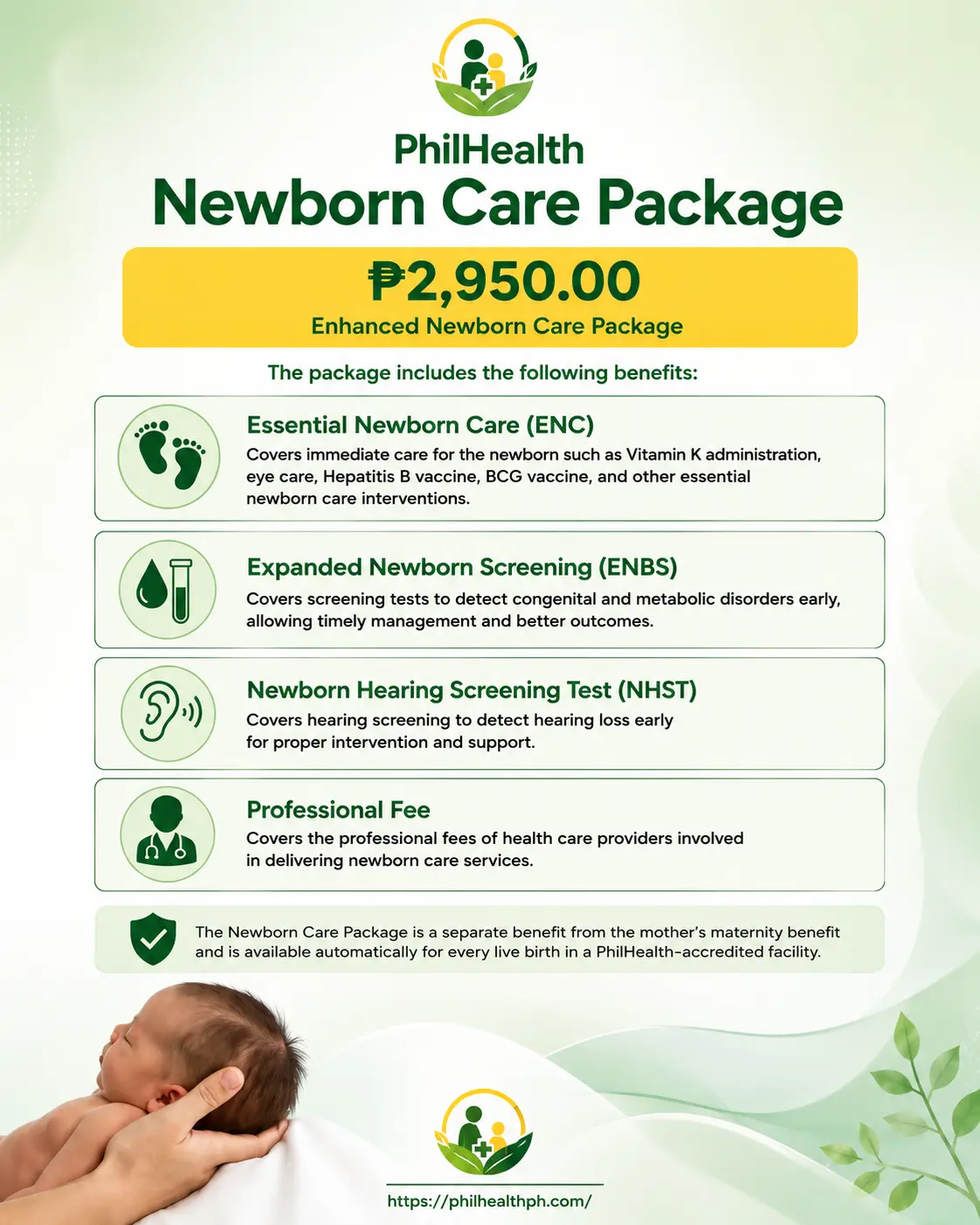
The Newborn Care Package was raised from ₱1,750 to ₱2,950 under Circular 2018-0021, effective January 6, 2019, and has been adjusted further in subsequent circulars as PhilHealth periodically revises its benefit packages. Since this figure changes over time, confirming the exact current amount through your hospital’s PhilHealth desk or PhilHealth’s official circular list beats relying on an older published number.
This amount covers the full bundle of services listed above, including supplies and professional fees tied to administering them. If your total newborn-related charges exceed the package amount, particularly at a private hospital, the difference becomes an out-of-pocket cost the same way it would with any other case rate.
To better understand how PhilHealth determines fixed benefit amounts for different medical services, read PhilHealth Case Rates Explained guide.
Who Qualifies and What Are the Requirements
Every newborn delivered at a PhilHealth-accredited facility qualifies automatically, as long as the mother is an active member or a properly declared dependent. The baby is issued a unique PhilHealth Identification Number upon registration or claims processing, establishing their own record in the system.
The main document families need to provide is the newborn’s birth certificate, submitted as a photocopy without the registry number for the initial claim, since the registered copy usually isn’t available yet at filing time. If the mother’s PhilHealth Benefit Eligibility Form (PBEF) already confirms active membership, Claim Form 1 usually isn’t required separately for the newborn.
If you’re unsure whether your membership status qualifies your newborn for coverage, see our PhilHealth Requirements by Member Type guide for a complete breakdown.
How the Claim Is Filed (and Why It’s Separate From the Mother’s)
The newborn’s claim doesn’t need to be attached to the mother’s delivery claim, and NCP claims are exempt from submitting a Statement of Account, unlike most other PhilHealth benefits. This separation exists because the baby is treated as their own patient with a distinct diagnosis and care record, even though delivery and newborn care happen during the same stay.
For most parents, this is handled entirely by the hospital’s PhilHealth desk, which files both claims using the appropriate codes without requiring separate paperwork from you. If the baby is later admitted for a related condition, such as newborn sepsis or congenital pneumonia, the Newborn Care Package can sometimes still apply as a second case rate.
The 24-Hour Rule and Newborn Screening Timeline
To qualify, the baby generally needs to remain in the facility for at least 24 hours after birth, except when immediate referral to a higher-level facility is medically necessary. Newborn screening is ideally performed after 24 hours of life but no later than three days from delivery for standard compensation.
Premature or sick newborns placed in intensive care are exempted from the strict three-day screening window, though they should still be tested within seven days of age. Official receipts for newborn screening need to fall within this same period, even if dated after discharge, so keeping that receipt rather than assuming it’s automatically filed is worth doing.
Common Mistakes That Delay a Newborn Claim
Troubleshooting
If the hospital’s PhilHealth desk flags an issue with the newborn’s claim, ask specifically whether it involves the birth certificate documentation, the newborn screening timing, or the mother’s underlying eligibility, since these are the most common causes.
If the mother’s own status is the issue, resolving her membership or contribution gap typically clears the newborn’s claim too, since the baby’s coverage depends on it. For unresolved cases, PhilHealth’s Corporate Action Center can look into the specific claim, referencing the newborn’s PIN once issued.
Tips for a Smooth Claim
Confirm the mother’s PhilHealth membership and contributions are current well before the due date, since the newborn’s coverage depends entirely on this. Keep the newborn screening receipt and any hearing test documentation in a safe place, since these support the claim’s compensability within the required window.
Ask the hospital’s PhilHealth desk directly about the current package amount, rather than relying on a figure from an older article. If the baby needs extended care beyond the standard 24-hour stay due to a medical referral, ask how this affects the package specifically, since exceptions apply for necessary transfers.
Frequently Asked Questions

I’m Dayon, and I run PhilHealthPH.com. I got tired of confusing, outdated instructions every time I had to deal with PhilHealth online, so I started writing the guides I wished existed — clear, current, and focused on actually getting the task done. Everything here is checked against PhilHealth’s official site and updated whenever their process changes.