
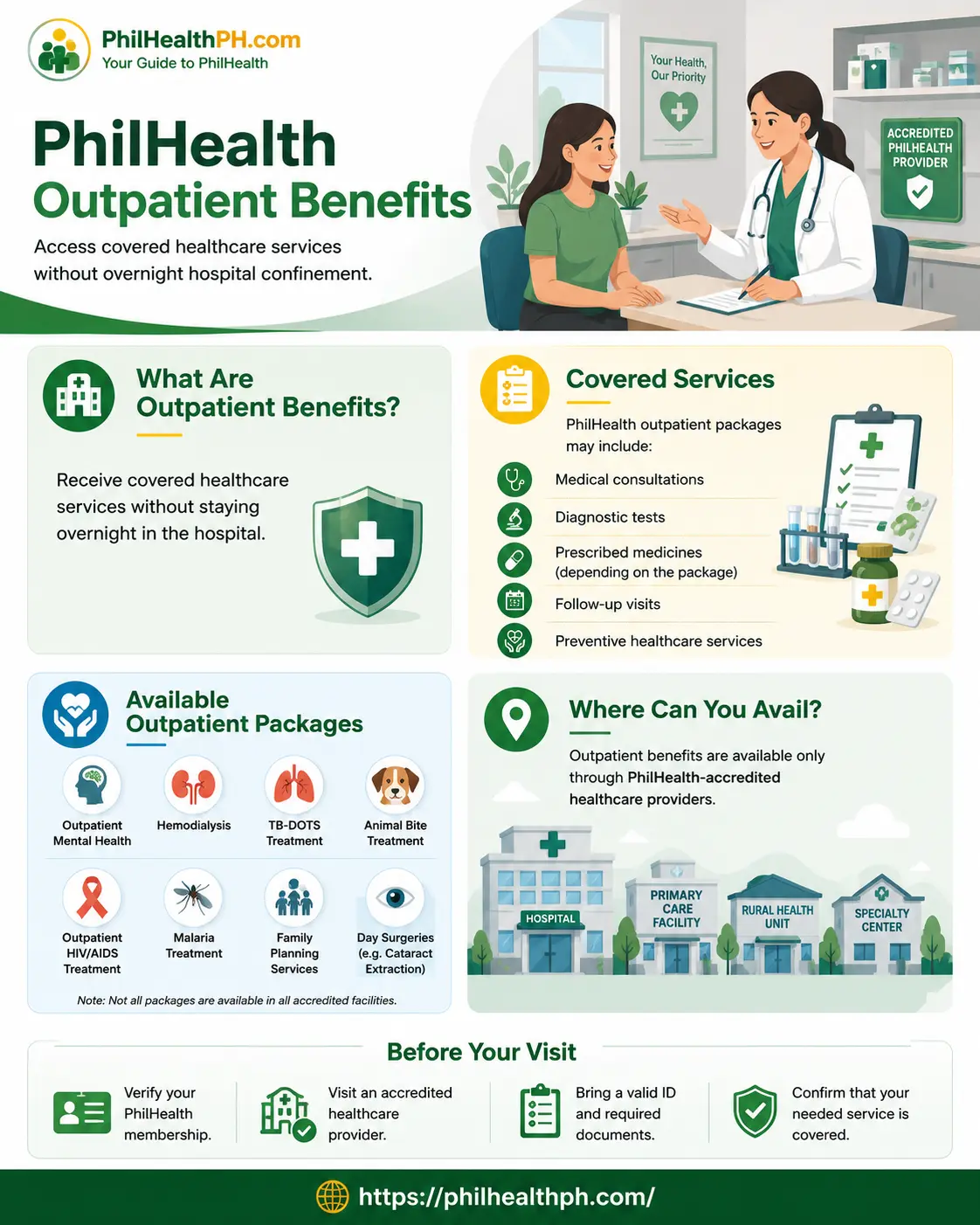
Yes, PhilHealth covers a wide range of outpatient services without requiring hospital confinement, including primary care consultations under YAKAP, hemodialysis, TB-DOTS treatment, animal bite treatment, outpatient HIV/AIDS treatment, malaria treatment, family planning procedures, and day surgeries like cataract extraction performed at ambulatory surgical clinics. Each package has its own accredited facility type and case rate, so coverage depends on visiting a provider specifically accredited for that particular service.
Outpatient care matters because it catches and treats conditions before they escalate into a costly hospital stay, and PhilHealth structures these packages to reduce or eliminate out-of-pocket cost at accredited public facilities. This article walks through every major outpatient package, where to access each one, and what to expect when availing.
What Counts as an Outpatient Benefit?
An outpatient benefit is any PhilHealth-covered service that doesn’t require an overnight hospital confinement, ranging from a routine primary care consultation to same-day procedures like cataract surgery or a single hemodialysis session. These are paid through their own case-based rates, separate from the inpatient hospitalization case rates used for confinements.
PhilHealth accredits facilities specifically for each type of outpatient package, meaning a hospital’s general accreditation doesn’t automatically cover every outpatient service. A facility needs a distinct accreditation as, for example, a Freestanding Dialysis Clinic or an Ambulatory Surgical Clinic before it can process claims under that specific package.
The Full List of PhilHealth Outpatient Benefit Packages
|
Package |
What It Covers |
Typical Facility |
|---|---|---|
|
Primary Care Benefit (YAKAP) |
Consultations, medicines, lab tests, cancer screening |
YAKAP-accredited clinics |
|
Hemodialysis |
Dialysis sessions for chronic and acute kidney conditions |
Freestanding Dialysis Clinics, hospitals, other accredited facilities |
|
Peritoneal Dialysis |
Alternative kidney dialysis method |
Peritoneal Dialysis Centers |
|
TB-DOTS |
Tuberculosis treatment, directly observed |
TB-DOTS accredited centers |
|
Animal Bite Treatment (ABPP) |
Anti-rabies vaccine and immunoglobulin for bite victims |
Animal Bite Treatment Centers |
|
Outpatient HIV/AIDS Treatment (OHAT) |
HIV treatment and monitoring |
OHAT Treatment Hubs |
|
Outpatient Malaria Package |
Malaria diagnosis and treatment |
Accredited malaria treatment providers |
|
Maternity Care Package (MCP) |
Prenatal visits, delivery, postnatal care |
Birthing homes, MCP-accredited facilities |
|
Family Planning Procedures |
Contraceptive procedures |
Freestanding Family Planning Clinics |
|
Day Surgeries (cataract, minor procedures) |
Same-day surgical procedures |
Ambulatory Surgical Clinics |
This isn’t an exhaustive list of every code PhilHealth maintains, but it covers the packages most Filipinos are likely to actually use. Newer additions, like the peritoneal dialysis Z Benefit expansion introduced in late 2024, show that PhilHealth continues to add and adjust outpatient coverage through regular circulars.
Primary Care (YAKAP): The Everyday Outpatient Benefit
YAKAP, PhilHealth’s primary care package, is the outpatient benefit most members interact with regularly, covering free consultations, medicines up to ₱20,000 a year, laboratory tests, and cancer screening once a member is registered and empaneled with a specific clinic. This replaced the older Konsulta program in 2025 with a meaningfully wider scope.
Unlike other outpatient packages tied to a specific illness, YAKAP is designed for ongoing, general primary care, the kind of visits that catch problems early rather than treat a single defined condition. Registration requires an in-person First Patient Encounter before benefits activate, so this isn’t something you can access on your first visit without having gone through that step beforehand.
Dialysis: Inpatient and Outpatient Combined
PhilHealth’s hemodialysis benefit covers both inpatient and outpatient sessions, including emergency dialysis for acute renal failure, and can be claimed even as a second case rate at full amount when performed alongside another condition during confinement. One outpatient session counts as one day against the 90-day annual benefit limit, and dialysis is specifically exempted from the Single Period of Confinement rule that otherwise treats related readmissions within 90 days as one continuous claim.
This benefit is no longer restricted to hospitals and freestanding dialysis centers; any accredited facility capable of providing the service under its DOH license can now process dialysis claims. For patients managing chronic kidney disease, this flexibility matters, since it widens where regular sessions can actually be accessed without losing PhilHealth coverage.
Day Surgery Through Ambulatory Surgical Clinics
Cataract surgery is probably the most commonly claimed procedure processed through PhilHealth’s ambulatory surgical clinic accreditation, since it’s routinely performed as same-day surgery without requiring an overnight stay. These clinics carry their own distinct accreditation separate from general hospital accreditation, and No Balance Billing generally applies to the services covered under this category for qualified members.
Other minor surgical procedures that don’t require confinement can also fall under this same accreditation type, depending on the specific procedure and facility capability. Confirming that your chosen clinic is specifically accredited as an Ambulatory Surgical Clinic, rather than assuming any PhilHealth-accredited facility qualifies, avoids a claim that doesn’t process the way you expect.
TB-DOTS, Animal Bite, Malaria, and HIV Treatment Packages
These four packages target specific public health conditions where early, consistent outpatient treatment prevents far more expensive complications later. TB-DOTS covers tuberculosis treatment delivered under the directly observed therapy short-course model, tracked across intensive and maintenance treatment phases. The Animal Bite Treatment Package covers anti-rabies vaccine doses and rabies immunoglobulin, administered on a specific schedule following an animal bite, which is why prompt treatment at an accredited Animal Bite Treatment Center matters more than waiting to see if symptoms develop.
The Outpatient HIV/AIDS Treatment (OHAT) package covers treatment and monitoring through designated Treatment Hubs, while the Outpatient Malaria Package covers diagnosis and treatment at accredited providers, most relevant in malaria-endemic provinces. All four packages are structured to keep treatment accessible and low-cost specifically because consistent adherence to the treatment schedule is what makes each program effective at the public health level.
How to Avail of Outpatient Benefits
Identify which specific package applies to your condition, since each has its own accredited facility type.
Confirm the facility’s specific accreditation, not just general PhilHealth accreditation, for that particular outpatient package.
Present your PhilHealth number or MDR at the facility, along with a valid ID.
Receive treatment, with the facility applying the case rate deduction directly in most instances.
Follow up as scheduled, particularly for multi-session treatments like TB-DOTS, dialysis, or the animal bite vaccination schedule, since missing steps can affect both your treatment outcome and how the claim is filed.
Most outpatient packages are processed by the facility directly, similar to inpatient case rates, so members generally don’t need to file separate paperwork with PhilHealth themselves.
Requirements
Some packages, like animal bite treatment, are urgent by nature and don’t require advance enrollment, while others, like YAKAP, require completing registration before you can access the benefit at all. See the full guide about PhilHealth Requirements by Member Type.
What’s Covered vs. What’s Not
Each outpatient package covers services explicitly defined within its own scope, such as the vaccine doses under the animal bite schedule or the specific tests and medicines under YAKAP. Services outside that defined scope, elective procedures unrelated to the covered condition, or care sought at a facility not accredited for that specific package, generally fall outside coverage and become an out-of-pocket cost.
This is why confirming accreditation for the exact package you need matters more with outpatient benefits than with general hospitalization. A hospital might be fully PhilHealth-accredited overall while still lacking accreditation for, say, the Outpatient Malaria Package specifically, meaning that particular service wouldn’t be covered there even though other services at the same facility are.
Common Mistakes
Troubleshooting
If an outpatient claim doesn’t process as expected, ask the facility’s PhilHealth desk whether the issue involves their specific accreditation for that package, your membership status, or a documentation gap.
If the facility genuinely isn’t accredited for the outpatient service you need, ask for a referral to a facility that is, rather than assuming the closest clinic automatically qualifies. For unresolved issues, PhilHealth’s Corporate Action Center can look into your specific claim with your PIN on hand.
Tips
Confirm a facility’s specific outpatient package accreditation before your visit, especially for planned or non-urgent care, rather than assuming any PhilHealth-accredited clinic covers everything. Keep your MDR and PhilHealth number easily accessible, since outpatient visits often move faster than hospital admissions and don’t leave much time to search for documents.
For multi-session treatments like dialysis or TB-DOTS, keep a personal record of your session dates alongside what the facility tracks, since this helps catch any discrepancy early. If you’re managing a chronic condition requiring regular outpatient visits, registering under YAKAP for your general primary care needs alongside your condition-specific package gives you broader coverage overall.
Frequently Asked Questions

I’m Dayon, and I run PhilHealthPH.com. I got tired of confusing, outdated instructions every time I had to deal with PhilHealth online, so I started writing the guides I wished existed — clear, current, and focused on actually getting the task done. Everything here is checked against PhilHealth’s official site and updated whenever their process changes.