
Quick Answer
To claim a PhilHealth refund, check first if your name appears on PhilHealth’s Unclaimed Refunds list on philhealth.gov.ph. If it does, bring two valid IDs to the nearest PhilHealth Regional Office or Local Health Insurance Office (LHIO) and fill out the Request for Release of Unclaimed Refund Form. You can choose to pick up your check personally or have it mailed. If you cannot go yourself, someone you trust can file on your behalf using a signed authorization letter, a valid ID, and a photocopy of your own ID.
Refunds confuse a lot of members because PhilHealth actually has more than one kind. Some refunds sit unclaimed for years after a hospital confinement. Others come from a billing dispute with a hospital that overcharged you. This article walks through both, starting with the one members search for most: the official unclaimed refund process.
What Is a PhilHealth Refund, Exactly?
A PhilHealth refund is money the corporation owes a member because part or all of an approved benefit payment never reached them at the point of care. This usually happens after a hospital confinement where the health institution under-deducted the case rate, or where the member didn’t fully avail of a benefit they were entitled to. PhilHealth is required by law to return this money, and it keeps a running list of members with unclaimed amounts on its official site.
The minimum refund amount PhilHealth releases is ₱100, though the actual figure depends entirely on what the accredited hospital reported for that specific confinement. Some members are surprised to find refunds tied to a hospital stay from several years back, since these lists cover confinements going as far back as 2007. Knowing which bucket your situation falls under saves you from following the wrong steps entirely.
What Causes an Unclaimed PhilHealth Refund?
An unclaimed refund happens for one of two reasons: an under-deduction at the hospital, or non-availment of a benefit the member was actually eligible for. In an under-deduction, the hospital applied less than the full case rate to your bill, leaving a balance PhilHealth still owes you.
In non-availment, you were confined but for some reason didn’t use the full benefit you qualified for, so PhilHealth holds the difference until you claim it.
Both situations are entirely on PhilHealth’s end to correct, not something the member caused. Hospitals are required to report these amounts to PhilHealth so the list stays updated, but reporting delays and address changes are the main reasons refunds go unclaimed for long periods.
This is separate from a hospital directly overcharging your out-of-pocket portion, which we cover further down since it follows its own process.
How Do You Know If PhilHealth Owes You a Refund?
You’ll know PhilHealth owes you a refund if your name appears on the official Unclaimed Refunds list published on philhealth.gov.ph, searchable by region and by name. The corporation updates this list periodically, so it’s worth checking again every few months if you had a confinement years ago and never followed up.
If you don’t see your name today, that doesn’t rule out a future refund, since new names get added as hospitals submit late reports.
You can also ask directly at your nearest LHIO if you suspect a refund is due but aren’t sure how to search the list yourself. Bring your PhilHealth Identification Number (PIN) and a valid ID so staff can pull up your record on the spot. This is often faster than scrolling through a long regional list on your phone.
PhilHealth Refund Process: Step-by-Step
Once you’ve confirmed your name is on the list, the actual claiming process is straightforward.

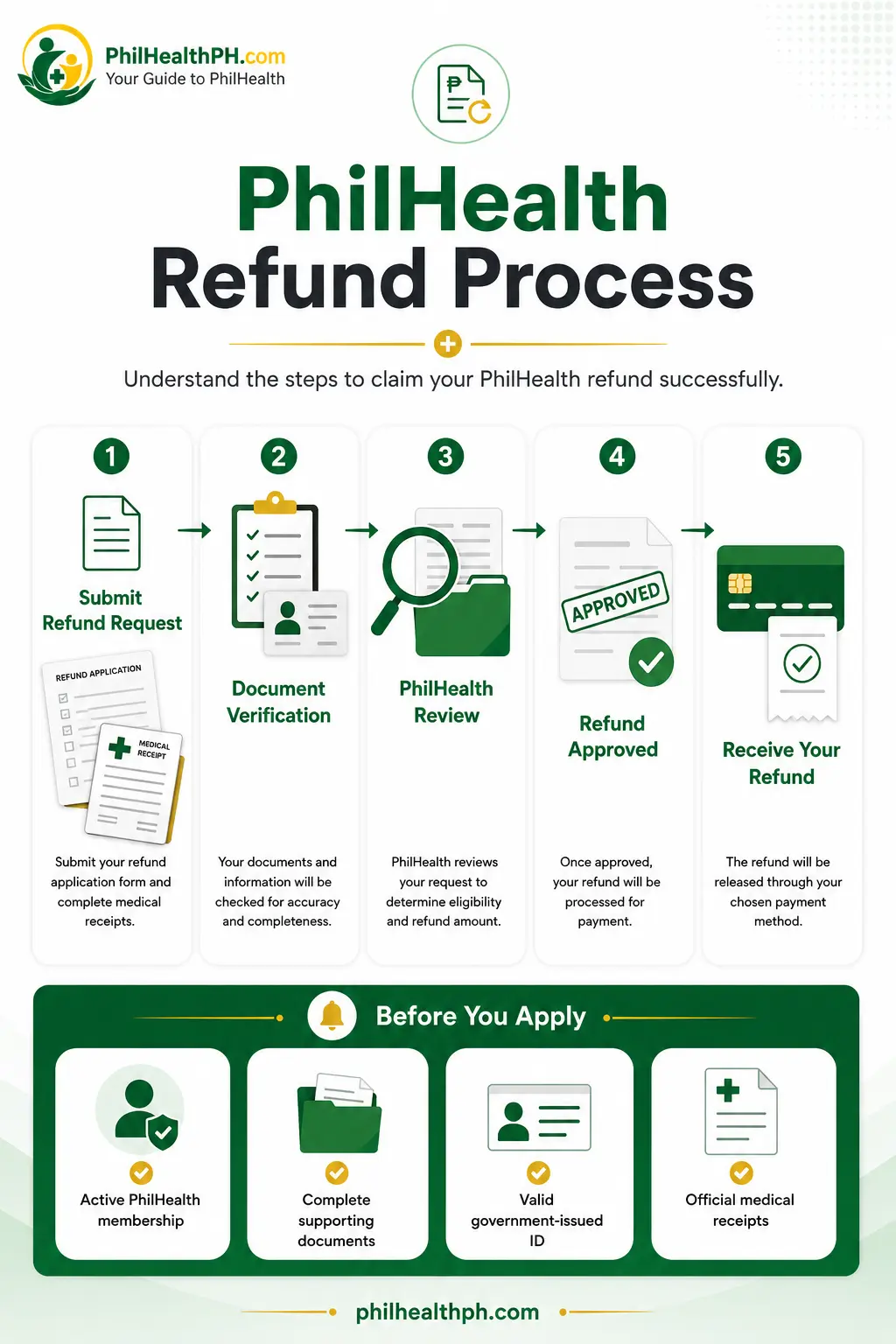
Confirm your name and confinement details on the Unclaimed Refunds page, noting the specific period and amount listed.

Prepare two valid, government-issued IDs, since PhilHealth requires this minimum for identity verification at the counter.

Visit your nearest PhilHealth Regional Office or LHIO. You don’t need to go to the branch where you were confined; any office can generally process the request.

Fill out the Request for Release of Unclaimed Refund Form provided by the staff on-site.

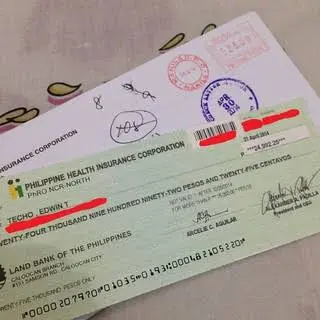
Choose your release preference: personal pickup of the check, or having it mailed to your registered address.

Wait for the release, following up if the timeline given at the branch has already passed.
If the confirmed member has since passed away, the next of kin or legal heir can claim the refund instead. In that case, bring the deceased member’s ID, a death certificate, your own valid ID, and documents proving your relationship, such as a birth or marriage certificate.
Requirements for Claiming a PhilHealth Refund
|
Requirement |
Applies To |
Notes |
|---|---|---|
|
Two valid government IDs |
All claimants |
Must show photo and signature |
|
Request for Release of Unclaimed Refund Form |
All claimants |
Filled out on-site at the branch |
|
Authorization letter + representative’s ID |
Representative filing for member |
Required if the member cannot appear in person |
|
Special Power of Attorney |
Representative, in some cases |
Requested for higher-value or contested claims |
|
Death certificate, proof of relationship |
Next of kin/heir |
Needed when the original member has passed away |
Bring photocopies of everything in addition to the originals, since some branches keep a copy on file before releasing payment. If any requirement is missing, most branches will simply ask you to come back rather than process an incomplete request.
How to Authorize Someone Else to Process Your Refund
If you’re an OFW, working out of town, or otherwise unable to visit a branch, you can send a representative with a properly written authorization letter. The letter should state your full name and PhilHealth PIN, name your representative exactly as it appears on their ID, and clearly describe that the transaction is for claiming an unclaimed refund. Sign it by hand and attach a photocopy of your own valid ID so staff can compare signatures.
For refund transactions specifically, it helps to have the letter notarized, or authenticated at a Philippine Embassy or Consulate if you’re abroad, since branches tend to apply closer scrutiny to any transaction involving a cash payout.
Is There a Fee to Claim a PhilHealth Refund?
There is no fee to claim a PhilHealth refund. The entire process, from checking the list to filling out the release form, is free of charge, since this is money PhilHealth already owes you rather than a new transaction you’re paying for. Be cautious of anyone online offering to “process” your refund for a fee or asking for advance payment, since PhilHealth never charges members to release their own money.
How Long Does the PhilHealth Refund Process Take? (Gaano Katagal?)
Once your documents are complete and verified at the branch, releasing a confirmed unclaimed refund typically doesn’t take long, since the amount has already been validated and simply needs to be disbursed. Members who choose personal pickup often receive their check the same day or within a few working days, while mailed checks depend on postal delivery to your registered address.
If your case requires additional verification, such as confirming a relationship for a deceased member’s claim, expect a longer wait while the branch cross-checks supporting documents.
If weeks pass with no update after a mailed request, it’s reasonable to follow up directly with the branch rather than assume the check is still in transit. Keep your reference or transaction slip from your visit, since this speeds up any follow-up call or inquiry.
Refund From Hospital Overpayment (A Different Process)
Not every “refund” search is about the official unclaimed list. Some members mean a situation where a hospital deducted less than it should have from PhilHealth, then charged the member more out-of-pocket than necessary. This is a billing dispute, and it’s resolved with the hospital first, not directly through the Unclaimed Refunds process.
Start by asking the hospital’s billing office for a re-computation, presenting your Statement of Account and PhilHealth deduction details. Most accredited hospitals have an internal process for this and will issue an adjusted bill or refund within a few days once the error is confirmed. If the hospital doesn’t cooperate, escalate to a PhilHealth CARES officer if one is stationed on-site, or contact the PhilHealth Action Center directly. For confinements where the hospital never filed anything at all and you paid entirely out of pocket, that’s a reimbursement claim rather than a refund, which follows its own document checklist and 60-day filing window.
Common Mistakes That Delay a PhilHealth Refund
Frequently Asked Questions

I’m Dayon, and I run PhilHealthPH.com. I got tired of confusing, outdated instructions every time I had to deal with PhilHealth online, so I started writing the guides I wished existed — clear, current, and focused on actually getting the task done. Everything here is checked against PhilHealth’s official site and updated whenever their process changes.