
If you’ve been trying to figure out whether you’re supposed to be paying PhilHealth contributions or not, you’re not alone. A lot of members only discover their actual classification when a hospital cashier asks for it, or when a benefit claim gets held up over a category mismatch. Understanding the difference between direct and indirect contributors clears up most of this confusion in a few minutes, and it can save you from an awkward situation at the admitting desk.
This article breaks down exactly what separates the two groups, who falls under each one, and what it means for your monthly payments and hospital benefits. We’ll also cover the mistakes members commonly make when they assume their category without checking, and what to do if your records don’t match what you think they should say.
What Are PhilHealth Direct and Indirect Contributors?
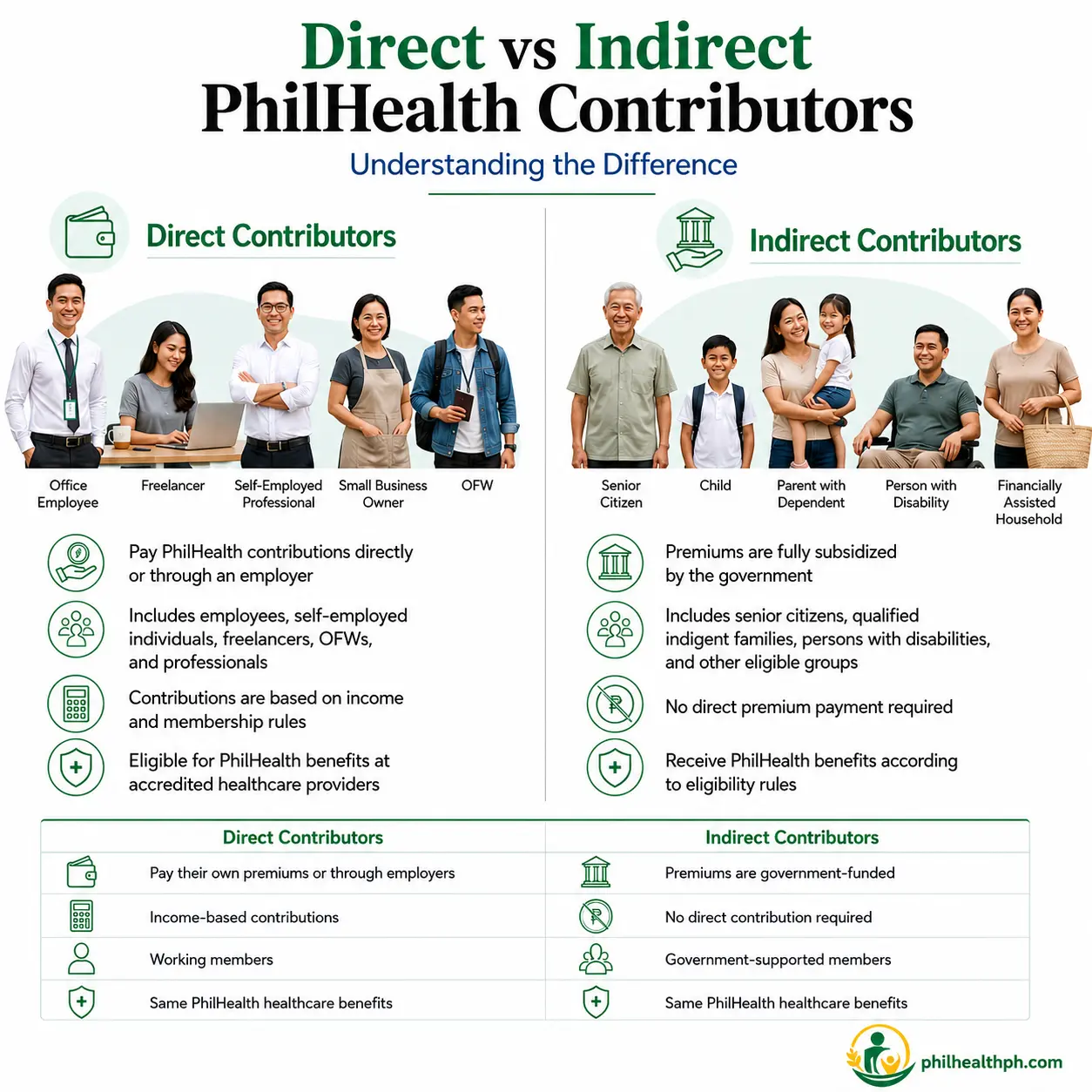
PhilHealth divides all its members into two broad groups under the Universal Health Care Act (Republic Act 11223): Direct Contributors, who pay their own premiums or share the cost with an employer, and Indirect Contributors, whose premiums are shouldered by the national government. Both groups are fully covered members of the National Health Insurance Program, and both can access PhilHealth benefits at any accredited hospital nationwide.
The distinction isn’t about who deserves coverage more. It’s about funding source and payment responsibility. A private employee and a senior citizen enrolled through their city hall both count as PhilHealth members with active coverage, but only one of them has a monthly contribution deducted from a payslip or bank account..
Who Qualifies as a Direct Contributor?
Direct Contributors are members who pay premiums themselves, whether personally or split with an employer. If you’ve ever seen a PhilHealth deduction on your payslip, or paid a contribution through GCash, a bank, or the PhilHealth Portal, you’re a Direct Contributor.
Employed Members
This covers workers in the private sector and government employees with an employer-employee relationship. The premium is split evenly, with half deducted from the employee’s salary and the other half shouldered by the employer, then remitted together every payroll cycle.
Self-Employed and Voluntary Members
Freelancers, business owners, online sellers, and professionals without an employer fall here. They declare their own monthly income and pay the full premium themselves, usually through the PhilHealth Portal or an accredited payment channel, since there’s no employer to cover half the cost.
OFWs and Kasambahay
Overseas Filipino Workers pay premiums based on declared income, often before deployment or through their manning agency, and are classified as Direct Contributors despite working abroad. Kasambahay, or household helpers, are also Direct Contributors, though their employer often covers the full premium if the helper’s monthly pay falls below a set threshold.
Who Qualifies as an Indirect Contributor?
Indirect Contributors don’t pay premiums out of pocket. The national government subsidizes their coverage in full, usually through budget allocations tied to specific laws.
Indigent Members (DSWD Listahanan)
Families identified as indigent through the Department of Social Welfare and Development’s Listahanan, the national household targeting system, are automatically enrolled as Indirect Contributors with no premium requirement on their end.
Senior Citizens
Under Republic Act 10645, all Filipino senior citizens are covered as Indirect Contributors regardless of income, even if they were paying as Direct Contributors before turning 60. This shift happens automatically in most cases, though members sometimes need to update their records to reflect it.
Persons With Disabilities (PWDs)
Republic Act 11228 mandates automatic PhilHealth coverage for PWDs as Indirect Contributors, meaning registered persons with disabilities don’t need to pay premiums to stay covered.
Sponsored Members
This includes members whose premiums are paid by a local government unit, a national agency, or another sponsoring body, often as part of a social welfare or health equity program rather than a personal enrollment.
Direct vs Indirect Contributors: Side-by-Side Comparison
|
Feature |
Direct Contributors |
Indirect Contributors |
|---|---|---|
|
Who pays the premium |
Member (alone or split with employer) |
National government |
|
Examples |
Employed, self-employed, voluntary, OFW, kasambahay |
Indigents, senior citizens, PWDs, sponsored members |
|
Monthly payment required |
Yes |
No |
|
Coverage for dependents |
Yes, automatically |
Yes, automatically |
|
Access to accredited hospitals |
Yes |
Yes |
|
Risk if payment lapses |
Coverage may be affected until settled |
Not applicable, since no payment is required |
Do Direct and Indirect Contributors Get the Same Benefits?
Yes, both groups receive the same core PhilHealth benefit packages, including inpatient confinement, case rate coverage, and access to the Z Benefits program for catastrophic illnesses. The law is explicit that indirect coverage should not translate into a lesser benefit package, since the goal of Universal Health Care is equal access regardless of payment source.
Where things can differ slightly is in additional or supplementary benefits, which the law allows Direct Contributors to access if applicable, though this doesn’t reduce what Indirect Contributors are entitled to. In practice, most members from either group experience identical treatment at the hospital counter, since PhilHealth accreditation rules apply the same way to every patient regardless of contributor type.
How to Check Which Category You Belong To
The fastest way to confirm your category is to check your Member Data Record (MDR) through the PhilHealth Portal, which lists your membership classification along with your contribution history. If you’ve never logged in before, you may need to complete online registration first to link your existing PIN to a portal account.
Members who registered years ago through an employer sometimes assume they’re still Direct Contributors even after retiring or turning 60, when in fact their status should have shifted to Indirect. Checking this directly through your MDR, rather than guessing based on old information, prevents confusion at a hospital admission desk later.
How to Register or Shift Categories
New members register through the standard PhilHealth registration process, where the system assigns a category based on the information declared on the Member Registration Form. If your situation changes, such as leaving employment to become self-employed, or turning 60 and qualifying for senior citizen coverage, you need to formally update your membership type rather than assuming PhilHealth will detect the change automatically.
For senior citizens specifically, the shift to Indirect Contributor status sometimes requires presenting a senior citizen ID or birth certificate at a PhilHealth branch if the system hasn’t already flagged the update. PWDs typically need to submit their PWD ID and supporting medical certification to be recognized under the indirect category.
Common Mistakes and Problems Members Run Into
A frequent issue is members continuing to pay voluntary contributions well past their 60th birthday, not realizing they already qualify for free coverage as senior citizens. Another common mistake is assuming indigent or sponsored status applies automatically without confirming enrollment in the DSWD Listahanan or a local sponsorship program, which can lead to unexpected billing at the hospital.
Some self-employed members also underdeclare their income to lower their contribution, which can complicate benefit computation later since PhilHealth benefits are tied to accurate contribution records. OFWs occasionally skip payment before deployment, assuming their manning agency handled it, only to find a gap in their coverage months later.
Troubleshooting: What to Do If Your Category Is Wrong
If your MDR shows the wrong classification, the fix usually starts with a visit or call to your nearest PhilHealth branch, bringing your valid ID and any supporting document relevant to your correct category, such as a senior citizen ID or DSWD certification.
For senior citizens whose accounts still show voluntary or self-employed status, request an official category update rather than simply stopping payment, since an unresolved discrepancy can delay a hospital claim.
Employed members who believe they were wrongly registered as voluntary, or vice versa, should coordinate with their HR department first, since employer-side registration errors are common and usually faster to correct through payroll records than through a walk-in request alone.
Practical Tips for Both Contributor Types
Direct Contributors benefit from reviewing their MDR at least twice a year to confirm payments are posting correctly and that their declared income still matches their actual earnings. Indirect Contributors, particularly seniors and PWDs, should keep a physical copy of their qualifying ID or certification on hand, since hospitals sometimes ask for it to confirm indirect status during admission.
Anyone unsure of their exact classification should resolve it before a medical emergency rather than during one, since correcting a misclassified account takes considerably longer when there’s already a hospital bill on the table. Keeping your registered mobile number and email updated also makes it easier to receive notifications if PhilHealth flags a category mismatch on its own.
Frequently Asked Questions

I’m Dayon, and I run PhilHealthPH.com. I got tired of confusing, outdated instructions every time I had to deal with PhilHealth online, so I started writing the guides I wished existed — clear, current, and focused on actually getting the task done. Everything here is checked against PhilHealth’s official site and updated whenever their process changes.