The PhilHealth contribution for OFWs in 2026 is 5 percent of declared monthly income, with a minimum of ₱500 a month and a maximum of ₱5,000 a month, translating to roughly ₱6,000 to ₱60,000 a year depending on income. Land-based OFWs typically pay the minimum tier unless they declare higher earnings, while sea-based OFWs follow a salary-based computation shared with their manning agency, similar to an employer split.
PhilHealth membership is mandatory for every OFW under the Universal Health Care Act, and payment can be made before departure, in a lump sum for the contract period, or periodically while working abroad. This article covers exactly how much to pay, where to pay it from overseas, and what happens to your coverage and your dependents’ benefits if a payment gets missed.
Is PhilHealth Mandatory for OFWs?
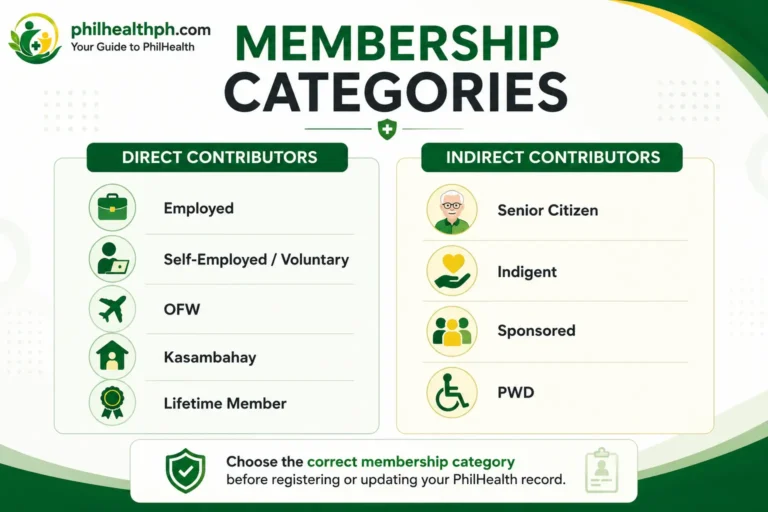
Yes, PhilHealth is mandatory for all Overseas Filipino Workers under Republic Act 11223, the Universal Health Care Act, which classifies OFWs as Direct Contributors required to pay premiums based on declared income. There’s currently a bill in the House proposing to make contributions optional for OFWs or shift more of the cost to employers, but it hasn’t been passed, so payment remains a legal requirement for now.
Some OFWs assume their foreign employer’s health insurance abroad makes PhilHealth unnecessary, but that coverage typically doesn’t extend to family members back home. PhilHealth membership is what keeps a spouse, child, or parent in the Philippines covered for hospitalization, maternity care, and other benefits while the OFW is working overseas.
How Much Is the PhilHealth Contribution for OFWs in 2026?
The 2026 contribution rate is 5 percent of monthly declared income, with a floor of ₱10,000 and a ceiling of ₱100,000 in income terms, meaning contributions range from ₱500 to ₱5,000 per month. This rate has held steady since 2025, since the scheduled increases under the Universal Health Care Law were completed and PhilHealth has confirmed no further rate hike for 2026.
|
Declared Monthly Income |
Monthly Contribution |
Annual Equivalent |
|---|---|---|
|
₱10,000 and below |
₱500 (minimum) |
₱6,000 |
|
₱20,000 |
₱1,000 |
₱12,000 |
|
₱30,000 |
₱1,500 |
₱18,000 |
|
₱50,000 |
₱2,500 |
₱30,000 |
|
₱100,000 and above |
₱5,000 (maximum) |
₱60,000 |
Most land-based OFWs end up paying at or near the minimum tier, since many declare income at the floor unless their actual verified earnings are documented higher. Since OFWs are self-paying members without an employer to split the cost, the full amount shown above is what you’re responsible for.
Land-Based vs. Sea-Based OFW Contributions
Land-based OFWs generally pay a flat ₱6,000 per year, equivalent to the ₱500 monthly minimum, unless they choose to declare and pay based on higher actual income. This amount is commonly paid in a single lump sum before departure, covering the full duration of a one-year contract, though monthly, quarterly, or semi-annual payment is also available for those who prefer to spread it out.
Sea-based OFWs, or seafarers, follow a different structure, since their premium is computed based on actual salary and split with their manning agency similarly to how an employer shares the cost with a land-based employee. This distinction matters because seafarers shouldn’t assume the flat land-based rate applies to them, since their contribution is typically higher and tied to their actual compensation package.
How to Pay a PhilHealth Contribution as an OFW
Generate your Statement of Premium Account (SPA) through the PhilHealth Member Portal before paying, since PhilHealth enforces a “No SPA, No Payment” policy for self-paying members.
Choose a payment channel that works from your location, including PhilHealth-accredited banks, remittance centers, Bayad Center, GCash, Maya, or direct payment at a PhilHealth office before departure.
Decide your payment frequency, whether a full lump sum for your contract period or a spread-out monthly, quarterly, or semi-annual schedule.
Complete the payment and save your receipt or reference number, since this is your proof if a posting issue comes up later.
Verify the payment posted by checking your contribution history through the Member Portal a few days after paying.
Paying before departure is the most common approach among land-based OFWs, since it means one less thing to manage once you’re already settled into work abroad.
Requirements for OFW Registration and Renewal
First-time OFW registrants need a valid passport, a completed PhilHealth Member Registration Form (PMRF), and proof of overseas employment such as an Overseas Employment Certificate or valid work contract. OFWs renewing an existing membership typically just need their PhilHealth number and updated employment or contract details if anything has changed since their last registration.
Many recruitment and manning agencies coordinate PhilHealth registration as part of standard pre-departure processing alongside OWWA membership, so first-time OFWs often complete this step without realizing it’s a separate government requirement from OWWA itself.
If your agency didn’t handle it, registering directly through the Member Portal or a PhilHealth branch before you leave avoids scrambling to sort it out while already abroad.
What Happens If You Miss a Payment
A missed or lapsed PhilHealth contribution can block your access to standard hospitalization and maternity benefits for the affected coverage period, though Z Benefits and other packages may still be reachable depending on your overall standing. Late payments also accrue interest, historically around 1.5 percent per month for self-employed and land-based OFW members.
PhilHealth introduced a one-time interest waiver program in 2026 under Circular 2026-0001, letting self-employed members, voluntary members, and OFWs settle old unpaid contributions by paying only the principal amount, without the compounded interest that would otherwise apply.
This waiver covers missed contributions going back years and runs through December 31, 2026, making this year a genuinely good window for any OFW carrying old arrears to catch up before standard penalty rates resume.
What Benefits Do OFWs and Their Dependents Get
An OFW’s PhilHealth membership extends the same coverage as any other member, including hospitalization, maternity benefits, outpatient primary care through YAKAP, and catastrophic illness coverage through the Z Benefit Package. Dependents back home, such as a spouse, children, or qualifying parents, access these benefits under the OFW’s membership as long as they’re properly declared and the OFW’s contributions are current.
This is the part that catches families off guard most often. A parent hospitalized in the Philippines while their OFW child is working abroad can be denied automatic coverage if the OFW’s contributions have lapsed or the parent was never formally listed as a dependent. Keeping both pieces current, active contributions and an updated dependent list, is what actually protects the family PhilHealth membership is meant to cover.
How to Claim Reimbursement While Abroad
If an OFW needs medical care while working overseas, PhilHealth allows reimbursement claims for eligible benefits availed abroad within 180 calendar days from discharge, or from the date of return to the Philippines, whichever applies. This is a longer window than the standard 60-day domestic deadline, since PhilHealth recognizes that gathering documents and mailing them from another country takes longer.
Claims filed for treatment abroad generally require the same core documents as a domestic reimbursement claim, translated into English if the originals are in another language, along with proof of payment and a medical report from the treating facility. Since PhilHealth has no accredited facilities outside the Philippines, this reimbursement route is the only option for care received while stationed overseas.
Common Mistakes OFWs Make With PhilHealth
Troubleshooting
If a payment made from abroad doesn’t reflect in your contribution history after several banking days, check that you generated a valid SPA before paying and that the payment channel you used is PhilHealth-accredited.
If the payment still isn’t posting correctly, contacting PhilHealth’s Corporate Action Center or emailing your regional office with your reference number and PhilHealth PIN is more effective than repeating the payment, since a duplicate transaction adds its own complications to resolve.
Tips for Managing Your Contribution From Abroad
Pay for your full contract period before departure whenever possible, since this removes the need to manage payments while adjusting to work and life overseas. Set a calendar reminder a month before your coverage period ends, rather than relying on memory once you’re settled into a routine abroad. Keep your dependents’ documentation, such as marriage and birth certificates, updated in PhilHealth’s system well before you actually need to rely on their coverage.
If you’re carrying old missed contributions, look into the 2026 interest waiver program before its December 31 deadline, since settling arrears at principal-only cost is a meaningfully better deal than paying compounded interest later.
Frequently Asked Questions
Final Thoughts
Staying on top of your PhilHealth contribution as an OFW comes down to a few consistent habits: paying for your full contract period upfront when you can, keeping your dependents properly declared, and checking your contribution history periodically rather than assuming a payment went through correctly. With the 2026 interest waiver giving OFWs a real opportunity to clear old arrears without the usual penalty, this is a good year to get your record fully current before that window closes. A membership that stays active protects more than just you, since it’s often the only safety net your family back home has while you’re building a better future abroad.

I’m Dayon, and I run PhilHealthPH.com. I got tired of confusing, outdated instructions every time I had to deal with PhilHealth online, so I started writing the guides I wished existed — clear, current, and focused on actually getting the task done. Everything here is checked against PhilHealth’s official site and updated whenever their process changes.