
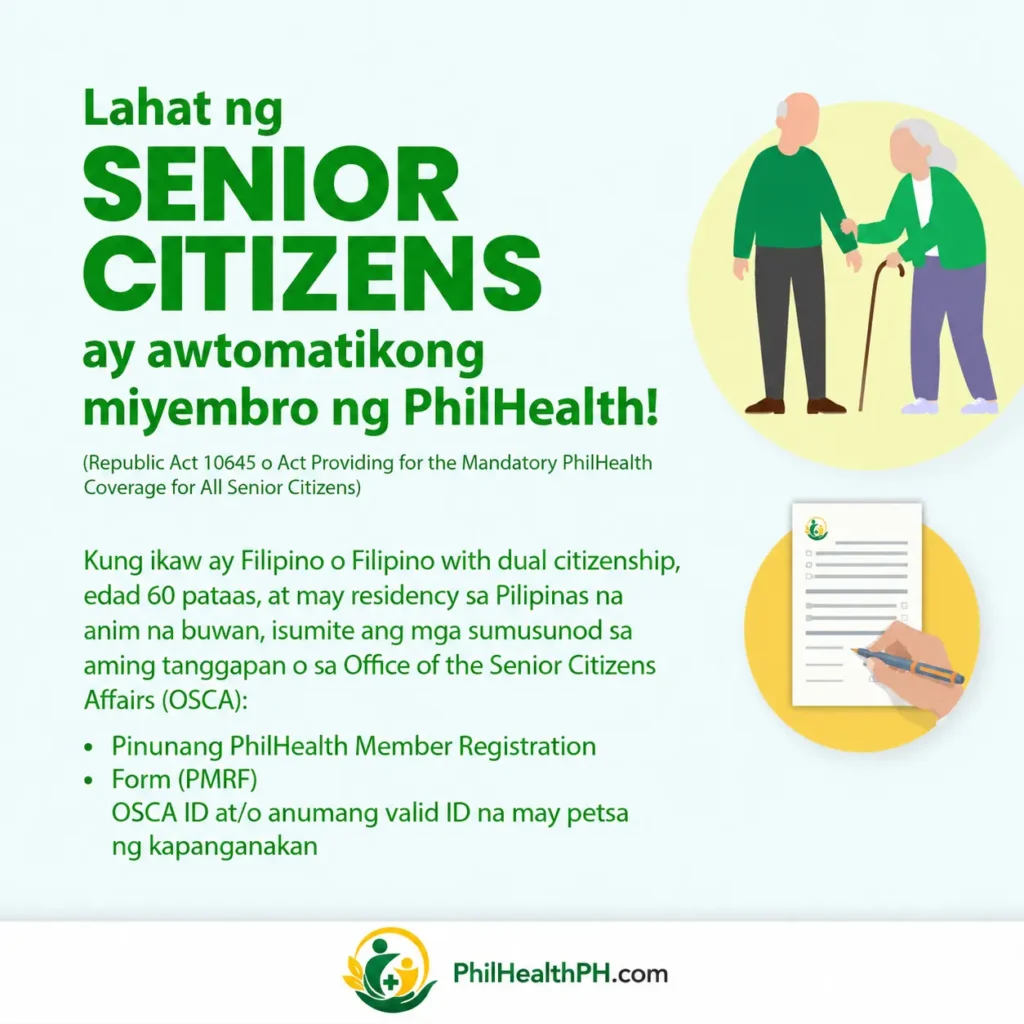
Yes, every Filipino aged 60 and above is automatically covered by PhilHealth under Republic Act 10645, with the government paying the premium through the Sin Tax Law rather than requiring any monthly contribution. This applies regardless of income or social status, as long as the senior citizen isn’t already covered under a different active membership category, such as being employed or a paying voluntary member.
Despite being “automatic” under the law, many seniors still aren’t properly recorded in PhilHealth’s system, since automatic coverage under RA 10645 doesn’t always mean an existing record was created without any action. Confirming or completing your enrollment through the Office for Senior Citizens Affairs (OSCA) or a PhilHealth branch is what actually gets your name into the system with a usable Member Data Record.
Is PhilHealth Really Free and Automatic for Senior Citizens?
Yes, PhilHealth coverage is genuinely free for senior citizens who don’t have a regular source of income or an active membership under another category, with the government covering the annual premium entirely through Republic Act 10645. This law amended the Expanded Senior Citizens Act by removing the earlier requirement that a senior citizen had to be classified as indigent before qualifying for free coverage.
The word “automatic” sometimes gives the impression that no action is needed at all, but PhilHealth still needs your information on file to issue a Member Data Record and process your benefits. Many seniors who assume they’re already covered discover otherwise only when a hospital admitting desk can’t find their record, so treating “automatic” as “eligible” rather than “already enrolled” is the safer way to think about it.
Who Qualifies Under RA 10645
Any Filipino citizen aged 60 or above qualifies for free PhilHealth coverage under RA 10645, including dual citizens aged 60 and above who can prove Filipino citizenship and at least six months of Philippine residency. The one condition is that the senior citizen must not already be covered under an existing PhilHealth membership category and must not have a regular source of income.
Seniors who are qualified dependents of another PhilHealth member, such as being listed under an adult child’s membership, are also covered without needing separate enrollment as a Senior Citizen member specifically. If a senior citizen is still working or earning regularly, they continue paying contributions under whatever category actually applies to them, such as Employed or Self-Employed/Voluntary, rather than qualifying for the free Senior Citizen category.
Requirements to Enroll or Confirm Your Coverage
A Senior Citizen’s Identification Card, issued by the Office for Senior Citizens Affairs (OSCA) in the city or municipality where the senior resides.
A valid government-issued ID, if the OSCA card isn’t yet available or as a backup form of identification.
A completed PhilHealth Member Registration Form (PMRF), indicating Senior Citizen as the membership category.
Proof of Filipino citizenship and residency, specifically for dual citizens applying under this category
Seniors without a regular income don’t need to submit financial documentation the way indigent applicants historically did, since RA 10645 removed that requirement entirely. This is one of the more meaningful differences between the current rule and the older, more restrictive version of the law.
Step-by-Step: How to Register or Update Your Record

Visit your local OSCA office, since PhilHealth has partnered with OSCA in most cities and municipalities to make senior citizen enrollment more convenient.

Fill out one copy of the PMRF, marking Senior Citizen as your membership category.

Present your Senior Citizen ID or a valid government ID for verification.

Submit the form through OSCA or directly at a PhilHealth branch, whichever is more accessible in your area.

Request your Member Data Record (MDR) once processing is complete, confirming your enrollment.

Keep a copy of your MDR on hand, since this serves as your proof of PhilHealth coverage at hospitals and clinics.
Registering through OSCA tends to be the more convenient route for most seniors, since local government units typically coordinate the paperwork directly rather than requiring a separate trip to a PhilHealth branch.
How to Get Your Senior Citizen PhilHealth ID (MDR)
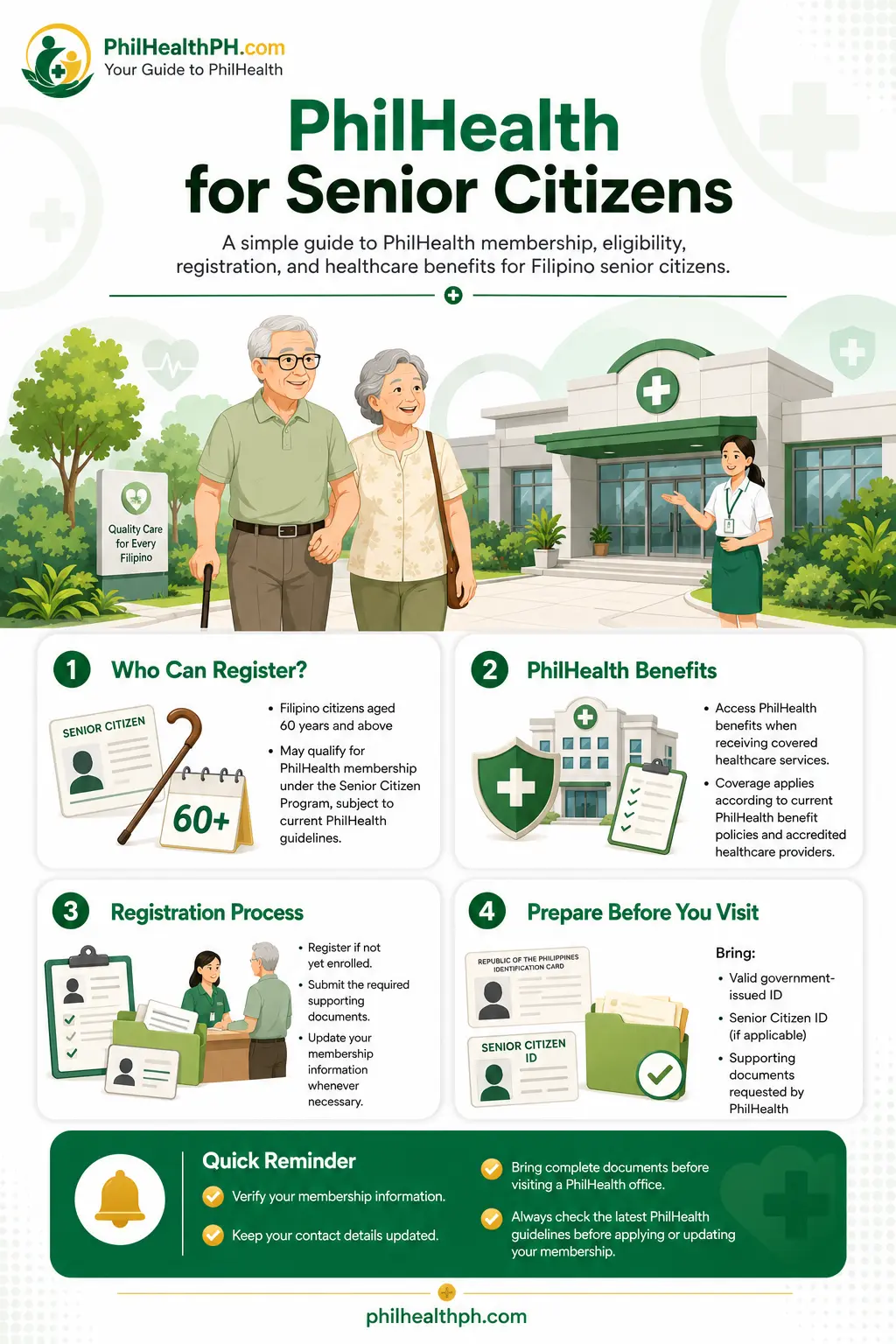
PhilHealth’s practical proof of membership is the Member Data Record (MDR), not a separate physical ID card, and seniors can request or print this once their Senior Citizen category registration is processed. Presenting the MDR alongside a valid ID at the hospital is what actually triggers the benefit deduction, so this document matters more day-to-day than any card design.
Some seniors ask specifically about a “PhilHealth ID card for senior citizens,” but in practice PhilHealth largely uses the MDR for verification rather than issuing a distinct card exclusively for this category. If a physical card was issued in the past and has since been lost, requesting a reprinted MDR through a PhilHealth branch or the Member Portal generally resolves the same need.
What If a Senior Citizen Is Already Employed or Has Regular Income?
A senior citizen who is still gainfully employed or has a regular source of income continues to pay PhilHealth contributions under their applicable membership category rather than automatically qualifying for the free Senior Citizen category. This is explicitly stated in PhilHealth’s own guidelines, since the free coverage under RA 10645 was designed for seniors without another paying membership already covering them.
This detail sometimes surprises retirees who assume turning 60 automatically switches them to free coverage regardless of continued income. If you’re still working past 60, checking with your employer’s HR department or a PhilHealth branch about which category currently applies to you avoids confusion about whether you should still be contributing.
What Benefits Do Senior Citizens Get?
Senior Citizen members and their qualified dependents have access to the same broad range of PhilHealth benefits available to any other member, spanning more than 4,000 case rate packages covering hospitalization, surgery, and outpatient care. Common examples include cataract surgery, treatment for pneumonia, cardiac care such as recovery from myocardial infarction, and cancer treatment through the Z Benefit Package where the specific diagnosis qualifies. Coverage extends to legal dependents of the senior citizen as well, not just the senior member themselves.
The savings this produces can be substantial in practice. Cataract extraction that would otherwise cost around ₱17,000 out of pocket has, for some PhilHealth-covered seniors, come down to only a few hundred pesos after the benefit was applied, and other seniors have reported saving tens of thousands of pesos on procedures like mastectomy once their PhilHealth coverage was properly recorded.

Using PhilHealth Coverage at the Hospital
Present your MDR along with a valid ID or Senior Citizen ID at the hospital’s admitting section, and the facility verifies your Senior Citizen coverage the same way it would for any other membership category. The case rate deduction for your specific diagnosis then applies automatically at accredited hospitals, the same process used across all PhilHealth membership types.
Since Senior Citizen coverage doesn’t require monthly contribution tracking the way voluntary membership does, there’s no need to check a payment history before a hospital visit. What does matter is confirming your MDR reflects your Senior Citizen enrollment correctly, since a record that was never properly created or updated is the main reason a hospital might not immediately recognize your coverage.
Common Mistakes That Delay Senior Citizen Enrollment
Troubleshooting
If a hospital can’t find a senior citizen’s PhilHealth record despite their age qualifying them under RA 10645, the most common cause is that formal registration was never completed, even though eligibility exists automatically under the law.
Visiting the nearest OSCA office or PhilHealth branch to complete or correct the registration, then requesting a fresh MDR, typically resolves this. For cases that remain unresolved, PhilHealth’s Corporate Action Center can look into the specific record, so having the senior citizen’s full name, birth date, and any prior PhilHealth number on hand speeds up the follow-up.
Tips
Register or confirm enrollment through OSCA well before a hospital visit is needed, rather than assuming eligibility alone is sufficient. Keep a printed copy of the MDR at home in an easily accessible place, since this is the document that actually gets checked at admission.
If a senior citizen in the family is still working, confirm with HR or a PhilHealth branch which membership category currently applies, since this affects whether contributions should continue. Family members helping an elderly relative through this process should bring the OSCA-issued Senior Citizen ID together with a valid government ID to avoid a second trip for missing documentation.
Frequently Asked Questions
Final Thoughts
RA 10645 genuinely made PhilHealth coverage a right rather than a privilege for every Filipino senior citizen, removing the old indigency requirement that used to leave many elderly Filipinos uncovered. The gap that still trips families up isn’t the law itself, but the assumption that automatic eligibility means an actual record already exists. A single visit to OSCA or a PhilHealth branch to confirm or complete that registration is usually all it takes to turn eligibility on paper into real coverage a senior citizen can actually use at the hospital.

I’m Dayon, and I run PhilHealthPH.com. I got tired of confusing, outdated instructions every time I had to deal with PhilHealth online, so I started writing the guides I wished existed — clear, current, and focused on actually getting the task done. Everything here is checked against PhilHealth’s official site and updated whenever their process changes.