
PhilHealth is the government’s mandatory national health insurance program, covering a fixed case rate portion of your hospital bill regardless of who you are. An HMO is a private, optional prepaid healthcare plan covering a wider range of services, including consultations and lab tests, and a larger share of hospital costs, but only at facilities within its specific network.
The two aren’t competing options; they’re designed to work together. PhilHealth handles the baseline deduction on nearly every confinement, while an HMO absorbs a bigger chunk of what’s left, plus everyday care PhilHealth doesn’t typically touch. Whether you need an HMO on top of PhilHealth depends on your job, your health risk, and how much out-of-pocket exposure you’re comfortable carrying.
What Is PhilHealth?
PhilHealth, formally the Philippine Health Insurance Corporation, is the government-owned national health insurance program, mandatory for every Filipino under Republic Act 11223. It’s funded through member contributions, deducted from an employee’s salary or paid directly by self-employed, voluntary, and OFW members.
PhilHealth pays through a case rate system: a fixed peso amount per diagnosis, deducted from your bill rather than a percentage of total charges. It also covers YAKAP primary care, maternity benefits, and catastrophic illness through the Z Benefit Package, at any accredited facility nationwide.
What Is an HMO?
An HMO, or Health Maintenance Organization, is a private, prepaid healthcare plan giving members cashless access to a specific network of hospitals and clinics, typically covering consultations, lab tests, hospital confinement up to a set limit, and sometimes dental care. Unlike PhilHealth, HMO enrollment is optional and usually comes through an employer.
The most recognized HMO providers in the Philippines include Maxicare, MediCard, Intellicare, PhilCare, and Cocolife Healthcare. Individual outpatient-only plans start around ₱999 a year, while comprehensive plans typically run ₱11,000 to ₱45,000 or more annually, depending on age and coverage level.
Key Differences at a Glance
|
Feature |
PhilHealth |
HMO |
|---|---|---|
|
Mandatory or optional |
Mandatory for all Filipinos |
Optional |
|
Provider |
Government (PhilHealth) |
Private company |
|
Payment structure |
Fixed case rate per diagnosis |
Benefit limit per confinement or annual cap |
|
Network |
Any PhilHealth-accredited facility nationwide |
Specific accredited hospitals and clinics only |
|
Outpatient coverage |
Limited, mainly through YAKAP primary care |
Broader, including routine consultations and diagnostics |
|
Typical cost |
5% of declared income (₱500–₱5,000/month) |
₱999 to ₱45,000+ per year depending on plan |
|
Dental coverage |
Not typically included |
Often included in mid-tier and higher plans |
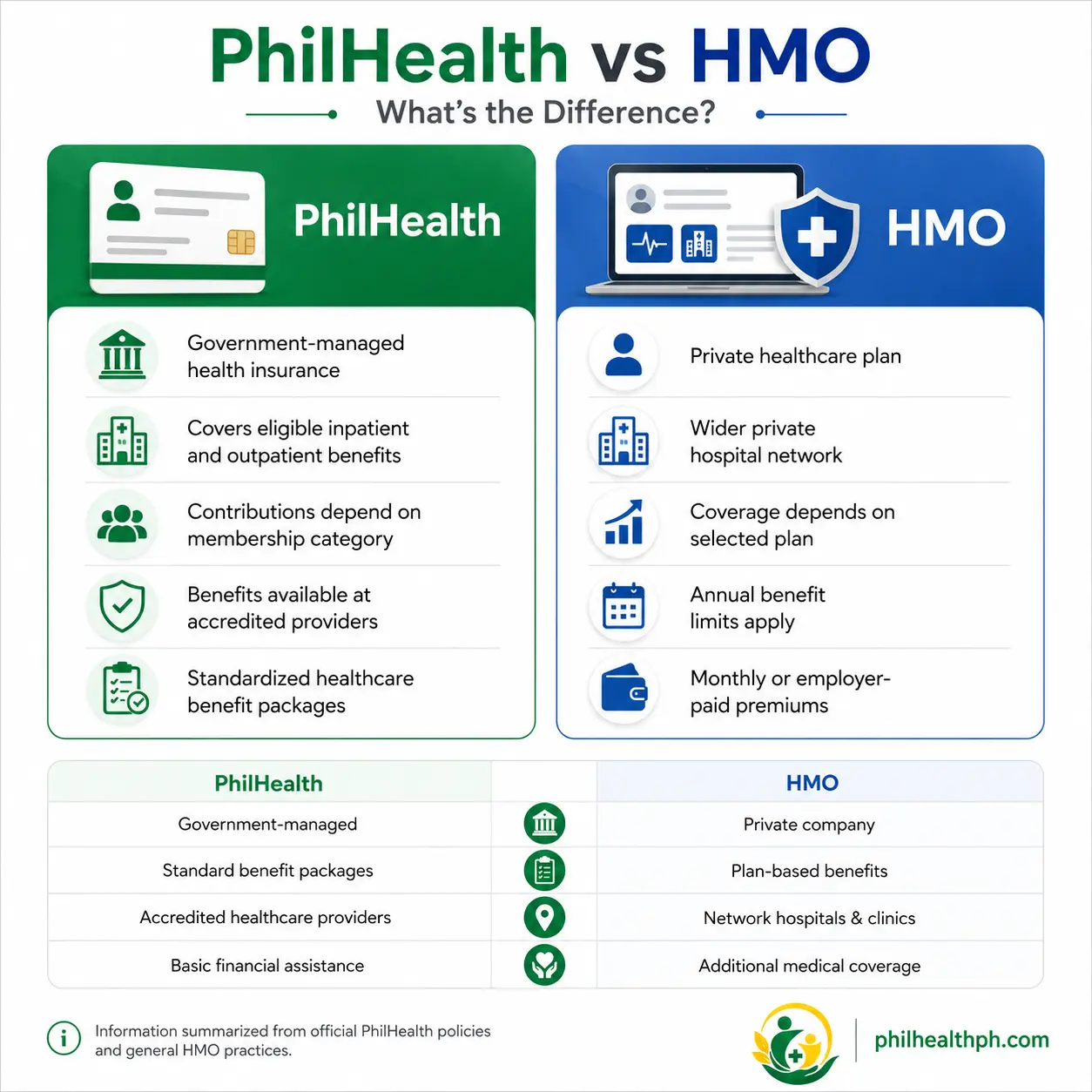
Coverage: What Each One Actually Pays For
PhilHealth’s core strength is universal, government-backed coverage for confinement and a growing set of outpatient packages, but its case rates often fall short of a private hospital’s actual charges. An HMO fills that gap, covering a larger share of the bill plus routine care PhilHealth doesn’t touch, such as physical exams and diagnostics unrelated to a confinement.
PhilHealth’s outpatient coverage centers on YAKAP, requiring registration with a specific clinic. An HMO’s outpatient coverage tends to be broader, letting members see specialists across a network without that requirement. Where PhilHealth pulls ahead is catastrophic illness coverage through the Z Benefit Package, since HMOs typically cap benefits at a fixed annual limit that catastrophic treatment can quickly exceed.
Cost: Contributions vs. Premiums
PhilHealth contributions are set at 5 percent of declared monthly income in 2026, with a floor of ₱500 and a ceiling of ₱5,000 a month, split with an employer for formally employed members. HMO premiums vary widely, ranging from under ₱1,000 a year for basic outpatient coverage to ₱45,000 or more annually for comprehensive plans with hospitalization, specialist visits, and dental care.
For employed Filipinos, HMO coverage is frequently provided free or heavily subsidized by the employer, making the actual out-of-pocket cost minimal. Self-employed individuals and freelancers considering an HMO on their own need to weigh the premium against their actual health risk and how much of a hospital bill they’d accept covering with PhilHealth’s case rate alone. If you’re self-employed or freelancing, our PhilHealth for Self-Employed and Freelancers guide explains how contributions are calculated, payment options, and what you need to stay eligible for PhilHealth benefits.
How Claims Work at the Hospital
Most PhilHealth-accredited private hospitals are also accredited by major HMOs, allowing what’s often called dual billing: PhilHealth deducts its case rate first, the HMO covers additional costs up to its own limit, and the patient pays only whatever balance remains. This combination is why many Filipinos with both types of coverage end up paying little to nothing for a routine hospital stay.
Most HMOs actually require an active PhilHealth membership as a condition of coverage, since the HMO expects PhilHealth’s portion to apply first. If a member’s contributions have lapsed, they may need to cover PhilHealth’s usual share out of pocket before the HMO benefit kicks in, a detail some members don’t realize until they’re already at the billing counter.
Do You Need Both?
Yes, for most Filipinos, having both provides meaningfully better financial protection than relying on either alone, since PhilHealth is mandatory and foundational, while an HMO covers what PhilHealth’s fixed case rates typically leave behind. PhilHealth alone rarely covers a private hospital bill in full, and an HMO alone doesn’t offer PhilHealth’s catastrophic illness coverage or universal nationwide accreditation.
Employed Filipinos with employer-provided HMO coverage get this combination automatically. Self-employed individuals, freelancers, and OFWs without employer-sponsored HMO face a genuine cost-benefit decision, since they’d pay the full HMO premium themselves on top of mandatory PhilHealth contributions.
Who Should Prioritize an HMO
Young professionals with generally good health but frequent minor illnesses often benefit most from an HMO’s outpatient-heavy coverage. Individuals with dependents, chronic conditions requiring regular consultations, or a preference for private hospital care also tend to find HMO coverage worth the added cost.
Retirees and seniors over 60 face a practical limitation, since most HMOs cap new enrollment around that age, making PhilHealth’s automatic, premium-free senior citizen coverage the more reliable long-term option.
If you’re 60 or older or planning for retirement, our PhilHealth for Senior Citizens guide explains eligibility, automatic coverage, available benefits, and what seniors should know before choosing an HMO.
Common Mistakes When Comparing the Two
Troubleshooting
If a hospital bill comes out higher than expected despite having both, ask billing to break down exactly how each deduction was applied, since a lapsed PhilHealth contribution or an exceeded HMO limit are the most common causes. If your HMO claim is denied for a facility you assumed was in-network, confirming accreditation directly with the provider before your next visit prevents a repeat issue.
Tips
Confirm your PhilHealth contributions are active before relying on dual coverage, since most HMOs expect that portion to apply first. Compare HMO plans by their actual benefit schedule and network hospital list, not just the premium price.
If you’re self-employed and weighing whether an HMO is worth the cost, consider your realistic health risk and whether your local hospital options are private facilities where PhilHealth’s case rate alone would leave a large balance. Review both types of coverage annually, since life changes can shift which combination makes sense.
Frequently Asked Questions

I’m Dayon, and I run PhilHealthPH.com. I got tired of confusing, outdated instructions every time I had to deal with PhilHealth online, so I started writing the guides I wished existed — clear, current, and focused on actually getting the task done. Everything here is checked against PhilHealth’s official site and updated whenever their process changes.